
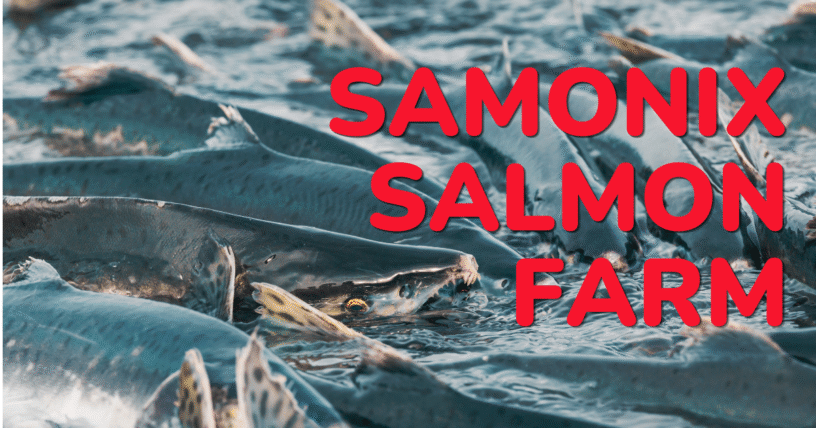


If you’ve heard whispers about a salmon farm coming to the
Pontiac, here’s a full update on where things actually stand.
What Is Samonix?
Samonix is a Chelsea-based company proposing to build a
large-scale, land-based Atlantic salmon farm in the Pontiac Industrial Park in
Litchfield, near Campbell’s Bay, right along the Ottawa River. If approved, it
would become Canada’s first large-scale land-based Atlantic salmon farm, and
the first salmon farming operation of any kind in the Ottawa River watershed.
The company is aiming to produce around 10,000 tonnes of
salmon annually, with a maximum proposed capacity of 12,000 tonnes, harvesting
close to three million fish a year. The facility would sit on a 5.6-hectare
site and carries an estimated price tag of roughly US$300 million (about C$418
million).
How It Would Work
Rather than raising fish in open-water pens, Samonix plans
to use a method called RAS, or Recirculating Aquaculture System. Fish would be
raised in large indoor tanks, with the water filtered, treated, and reused,
recirculating approximately 99 percent of the water in the system. The company
says this approach lets it raise salmon free of antibiotics, pesticides, and
hormones, while dramatically reducing the facility’s environmental footprint
compared to traditional fish farming.
Solid waste, including fish sludge and uneaten feed, would
be removed from the site rather than discharged into the river.
Who’s Behind It
Samonix says the company will always be majority
Quebec-owned, with 51 percent ownership held locally in Quebec or the
Outaouais. To bring the technical expertise needed for a project like this,
Samonix has partnered with a handful of international specialists: Norway’s
Smart Salmon for salmon-raising expertise, Sweden’s Smögenlax for the water
treatment system, and Israel’s Aquamaof for the core recirculating technology.
The project has also received public support in the form of
a $99,998 repayable contribution from Canada Economic Development for Quebec
Regions in 2024, to help fund preliminary studies.
The Environmental Concerns
This is where the project has drawn the most attention
locally. Quebec’s environmental review process required Samonix to go back and
conduct additional studies after regulators and environmental groups raised
concerns about the temperature and chloride content of the water the facility
would discharge into the Ottawa River.
In response, Samonix redesigned parts of the project: moving
its proposed discharge pipes away from habitat used by the endangered
hickorynut mussel, and adding diffuser technology intended to dilute chloride
in the treated wastewater more quickly.
Ottawa Riverkeeper, which has been in direct dialogue with
Samonix throughout the process, has said its modelling indicated chloride
concentrations in the discharge could reach acute toxicity thresholds before
being diluted in the river. However, the organization has also said the
relocated outlet and updated modelling should help mitigate those potential
impacts on the surrounding ecosystem.
Local concerns haven’t been limited to environmental groups.
At a public consultation held in Campbell’s Bay, Portage du Fort’s mayor raised
questions about whether the village, whose water filtration plant sits just
downstream of the proposed site, would need to conduct additional water testing
as a result of the project.
Where Things Stand With Regulators
The project is currently going through Quebec’s
environmental review process via the BAPE (Bureau d’audiences publiques sur
l’environnement), the province’s independent public body responsible for
environmental consultations. A public information session was held in early
June at the Campbell’s Bay Recreation Centre, with a formal public information
period running from late May through late June.
Samonix is also in the process of securing permits from
Quebec’s Ministry of the Environment, and has submitted its energy requirements
to Hydro-Québec.
What’s Next
Samonix cannot begin construction until it secures both
regulatory approval and financing. If both come together as planned, the
company expects construction to start in late 2027, with Atlantic salmon eggs
imported from Iceland in 2029, and the first commercial harvest completed in
2031.
If it goes ahead, the facility would initially supply
markets in Quebec and Ontario, with the northern United States identified as a
future market down the road.
Why It Matters for the Pontiac
A project of this size, both in scale and cost, would be a
significant development for the region: new jobs, new investment, and a
foothold in an emerging industry. At the same time, its location directly on
the Ottawa River means environmental questions, particularly around water
quality and impacts downstream, are likely to remain part of the conversation
as the project moves through the regulatory process.

Leave a Reply